As electric vehicle (EV) adoption surges across Malaysia, driven by attractive tax incentives and an expanding model lineup from BYD, Tesla, smart, and BMW, strata residents face a unique hurdle: charging at home. Unlike landed homeowners who can commission a 7.4kW single-phase or 11kW/22kW three-phase wallbox with minimal friction, condominium and apartment dwellers must navigate the legal, structural, and electrical complexities enforced by the Strata Management Act 2013 (Act 757), the Joint Management Body (JMB) or Management Corporation (MC), and Suruhanjaya Tenaga (ST) guidelines.
At Amtech EV, our certified electrical engineering team specializes in strata EV infrastructure. In this master guide, we break down the exact engineering architectures, regulatory approvals, safety compliance protocols, and transparent cost calculations required to install an EV charger at your multi-storey residence in Malaysia.
Understanding the Strata Dilemma: Act 757 & Common Property
Under the Strata Management Act 2013 (Act 757), your allocated car park bay is typically classified in one of two ways:
- Accessory Parcel: Legally tied to your strata title deed. While you hold proprietary rights over the bay, you do not own the structural pillars, ceiling risers, cable trays, or walls surrounding it—these remain common property.
- Common Property (Assigned/Rented Bay): Owned collectively by the parcel owners and managed by the MC/JMB for exclusive or open use.
Key Legal Consideration: You cannot drill into common pillars, run armored cables through common riser shafts, or connect to the building's electrical infrastructure without written approval from the JMB or MC. Doing so without approval violates Act 757 by-laws and exposes you to reinstatement orders, daily fines, and substantial civil liabilities in the event of an electrical fire.
3 Technical Architectures for Condominium EV Charging
Before submitting your paperwork to building management, you must identify which electrical distribution topology suits your building's infrastructure.
Option 1: Direct Connection to Unit's TNB Meter (The Direct-Run Method)
In this architecture, a dedicated sub-circuit is routed directly from your private residential unit’s distribution board (DB) or from your designated TNB meter panel located in the building’s central meter room down to your car park bay.
- Billing: Direct billing under your existing TNB Domestic Tariff A account. You can leverage the newly updated TNB Time-of-Use (ToU) scheme where off-peak charging provides significant cost savings.
- Technical Constraints: Feasible only if your parking bay is within reasonable proximity to the meter room (typically podium floors). Cable runs exceeding 60–80 meters induce severe voltage drop (which must not exceed 4% per MS IEC 60364) and dramatically escalate cabling costs.
- Capacity: Limited by your unit's existing main incoming supply breaker (typically 40A or 63A single-phase). Charging at 32A (7.4kW) while operating air-conditioners and induction cookers will cause nuisance tripping unless a Dynamic Load Balancing (DLB) wallbox is deployed.
Option 2: Tapping from Common Area Distribution Board with a Smart Sub-Meter
The charger connects to the nearest common area DB (e.g., carpark lighting DB or ventilation DB), provided the sub-station transformer and busbar have surplus ampacity determined through a Maximum Demand (MD) load profile study.
- Billing: You install a certified, MID-approved digital energy meter (kWh meter) equipped with RS485 Modbus or 4G/Wi-Fi telemetry. You reimburse the JMB/MC monthly at a rate agreed upon in the Deed of Indemnity (typically pegged to TNB Commercial Tariff C1 or the top tier of Domestic Tariff A: RM0.571/kWh).
- Advantage: Short cabling distances, minimal core-drilling, and clean aesthetic integration.
- Challenge: Requires JMB/MC willingness to handle manual billing or integration with an automated billing management system.
Option 3: Turnkey Centralized EV Charging Management System (CPMS / OCPP Model)
The definitive, future-proof solution for forward-thinking properties. Amtech EV installs a dedicated, commercial-grade sub-switchboard with Open Charge Point Protocol (OCPP 1.6J or 2.0.1) compliance. Residents activate charging via an app, RFID card, or automated payment gateway.
- Billing & Management: 100% automated. The third-party software handles load management, billing, payment collection, and utility disbursement to the MC without burdening the building management office.
- Dynamic Load Shedding: Ensures the EV cluster never exceeds the building’s maximum approved capacity, completely eliminating transformer overload hazards.
Mandatory Safety & Electrical Standards (Suruhanjaya Tenaga & Bomba)
The Energy Commission (Suruhanjaya Tenaga) published rigorous safety directives under the Guide on Electric Vehicle Charging System (EVCS) Installation. Non-compliant DIY installations carry immense legal risk.
1. Residual Current Protection (MS IEC 61851-1 & IEC 62955)
Every EV charging point must have dedicated residual current protection against AC and DC earth leakages:
- Requirement: A Type B RCCB, OR a Type A RCCB coupled with a 6mA Residual Direct Current Detection Device (RDC-DD).
- Engineering Insight: Standard Type A RCCBs found in Malaysian homes blind and fail to trip when exposed to DC residual leakage currents exceeding 6mA generated by an EV’s onboard AC-to-DC converter.
2. Earthing Architecture (TT vs TN-C-S System)
Per ST regulations, EV charging circuits must possess a dedicated earth return path. If tapped off a TT system, the earth electrode resistance must measure below 10 Ohms. The earth fault loop impedance must ensure disconnection times within 0.4 seconds under fault conditions.
3. JBPM (Fire & Rescue Department of Malaysia) Guidelines
For basements and covered parking areas, Jabatan Bomba dan Penyelamat Malaysia mandates:
- Installation of a dedicated manual Emergency Stop Button (Mushroom-head push button) adjacent to the charger at a height between 1.2m and 1.5m.
- Clearance from critical escape staircases, flammable storage enclosures, and wet-riser landings.
- Direct line-of-sight to CCTV monitoring and placement within reach of building sprinkler heads or specialized fire-extinguishing equipment.
Complete Cost Breakdown (Malaysian Strata EV Installation)
Below is a realistic, itemized breakdown for a certified condominium EV wallbox installation in Ringgit Malaysia (RM), based on an average 30-meter to 50-meter cable run.
| Component / Scope of Work | Technical Specifications | Estimated Cost (RM) |
|---|---|---|
| EV Wallbox Charger (Hardware) | 7.4kW Single-Phase or 11kW/22kW Three-Phase (Type 2, RFID, Smart App, Dynamic Load Balancing ready) | RM2,200 – RM4,500 |
| Circuit Breakers & RCD Protection | Type B RCCB (or Type A + 6mA DC RDC-DD) + Miniature Circuit Breaker (MCB/MCCB) in IP65 Enclosure | RM450 – RM950 |
| Heavy-Duty Power Cabling | 3-Core or 5-Core Armored XLPE Cable (6mm² to 10mm²), running through GI conduit or metal trunking (30m - 50m) | RM1,500 – RM3,200 |
| Bomba Emergency Cut-Off & Accessories | IP66 Mushroom Emergency Stop Button, heavy-duty rotary isolator switch within 1m of bay | RM350 – RM600 |
| Smart Energy Sub-Meter | MID-certified 1-Phase / 3-Phase digital kWh meter with RS-485 / Wi-Fi capability for JMB billing | RM250 – RM650 |
| Engineering Endorsement & Testing | Inspection, insulation resistance testing, earth loop test, and sign-off by an ST-Registered Wireman (PW4) or Chargeman | RM400 – RM800 |
| JMB / MC Security Deposit | Refundable renovation deposit payable directly to building management prior to commencement | RM1,000 – RM2,000 (Refundable) |
| TOTAL ESTIMATED CAPITAL OUTLAY | Turnkey compliant installation (Excluding refundable deposit) | RM5,150 – RM10,700 |
Tax Benefit Reminder: Under the Malaysian Budget, individuals can claim up to RM2,500 in personal income tax relief with LHDN for EV charging equipment purchases, hardware, and certified installation costs. Retain all official tax invoices and completion certificates issued by Amtech EV to qualify.
Step-by-Step JMB/MC Approval Process: The Amtech EV Blueprint
- Preliminary Site Audit: Contact Amtech EV to perform a technical feasibility inspection. We evaluate meter room capacity, cable pathway distances, available breaker slots, and cellular signal strength for smart billing.
- Engineering Proposal Dossier: We provide you with a comprehensive submission pack for your JMB/MC:
- Single-Line Diagram (SLD) endorsed by a qualified electrical engineer.
- Product datasheets confirming MS IEC 61851-1, MS IEC 62196-2, and SIRIM approvals.
- Contractor CIDB registration and RM1,000,000+ Public Liability Insurance policy.
- Method Statement and Risk Assessment (HIRARC) for the installation work.
- Execution of Deed of Indemnity: You and the JMB/MC sign a standardized legal undertaking outlining ownership, tariff reimbursement rates, maintenance liability, and terms for removal upon property disposal.
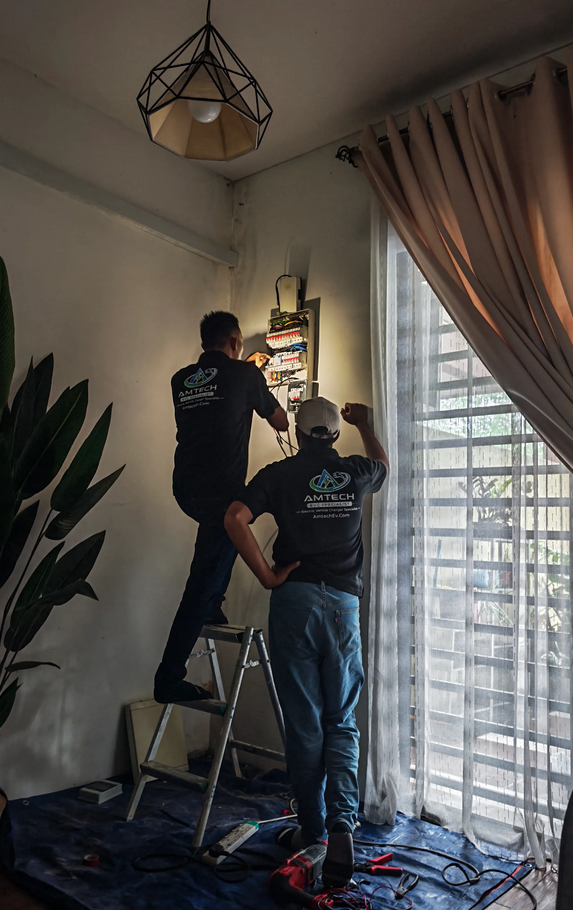
- Certified Installation & Commissioning: Our certified wiremen lay cabling via designated cable trays, install fire collars where walls are breached, commission the wallbox, and verify all earth loop values.
- Final Handover: Submission of the testing certificate (Form G/H equivalent compliance) to the Building Management Office for the release of your renovation deposit.
Frequently Asked Questions (FAQ)
1. Can the JMB or Management Corporation flatly reject my application to install an EV charger?
Under the Strata Management Act 2013, the JMB/MC manages common property on behalf of all owners. While they have the power to regulate modifications to common infrastructure, outright unreasonable refusals can be challenged through the Strata Management Tribunal (SMT). Presenting a professionally prepared engineering dossier that demonstrates zero structural impact, certified safety cut-offs, and an indemnified billing structure resolves nearly all committee objections.
2. Will my 7.4kW or 11kW charger cause tripping to the condo's common electrical supply?
No, provided a proper Maximum Demand assessment is performed prior to connection. Professional installations utilize Dynamic Load Balancing (DLB) or dedicated breakers matched strictly to the distribution board’s headroom. If common capacity is constrained, wallbox hardware can be capped via software or hardware dip switches to charge at 16A (3.7kW or 11kW) during peak building hours.
3. What happens if I move out or sell my condominium unit?
Under the standard Deed of Indemnity, you have two options: transfer the charging infrastructure to the new parcel owner via mutual agreement endorsed by the MC, or engage an authorized installer like Amtech EV to decommission the wallbox, isolate the supply cabling safely, and reinstate the wall finish to management satisfaction.
4. Can I use a regular 3-pin 13A plug (portable "granny charger") in the carpark instead?
Strictly discouraged and frequently prohibited by JMBs. Standard 13A domestic sockets (BS 1363) are not designed to endure continuous full-load draw (10A–13A) for 8 to 14 hours. This practice generates excessive thermal stress, degrades the socket contacts, and creates a critical fire hazard. Furthermore, using unmetered common 3-pin plug points constitutes electricity theft under Section 37 of the Electricity Supply Act 1990.