The Strata Dilemma: Installing an EV Charger in Malaysian Condominiums
Transitioning to an electric vehicle (EV) while living in a landed property in Malaysia is relatively straightforward. However, for the millions of Malaysians residing in high-rise condominiums, serviced apartments, and townhouses, setting up private charging facilities presents significant technical, bureaucratic, and legal hurdles. Under the Strata Management Act 2013 (Act 757), parking bays, electrical risers, and main switchboards (MSB) are classified as either common property or limited common property under the stewardship of the Joint Management Body (JMB) or Management Corporation (MC).
As certified electrical engineers and EV charging infrastructure specialists at Amtech EV, we regularly engage with condominium management committees that reject homeowner applications outright due to misinformed safety concerns, electrical load anxieties, or ambiguous billing frameworks. This comprehensive technical guide outlines the exact roadmap to secure JMB/MC approval, navigate Suruhanjaya Tenaga (Energy Commission) standards, satisfy Jabatan Bomba dan Penyelamat Malaysia (JBPM) fire codes, and accurately budget your installation costs.
Understanding the 3 Power Sourcing Architectures in Strata Properties
Before submitting any paperwork to your building management, an accredited electrical engineer or certified wireman must conduct an on-site feasibility study to determine how electrical power will be routed to your designated parking bay. In Malaysia, there are three recognized wiring typologies for strata developments:
1. Direct Feed from the Owner's Unit Sub-DB (Dedicated Tapping)
This is the most seamless method for homeowners if their assigned car park is physically close to their private electrical intake or meter compartment (typically common in lower-level podium parking). A dedicated circuit is pulled from your apartment unit’s distribution board (DB) through the building's electrical riser down to your parking bay.
- Billing: Directly billed to the homeowner's existing TNB Domestic Tariff A account. No complex reimbursement mechanism needed with the JMB.
- Technical Constraints: Requires single-phase (up to 7.4kW / 32A) or three-phase (up to 11kW / 16A per phase) capacity verification. Long cable runs across multiple floors can result in unacceptable voltage drops exceeding 4%, necessitating thick, costly armored copper cables (e.g., 6mm² or 10mm² 3-core/5-core XLPE/SWA/PVC).
2. Common Area MSB/Sub-Switchboard Tapping with Smart Private Metering
When tapping from the owner's residential unit is physically impossible or cost-prohibitive due to distance, the EV charger can be fed directly from the common area electrical distribution board (Sub-DB or MSB) located in the carpark basement.
- Billing: The common property draws power from TNB under commercial or high-voltage tariffs. The EV charger must integrate a certified, MID-compliant digital smart sub-meter or utilize an OCPP 1.6J/2.0.1 cloud billing backend (such as those configured by Amtech EV) to automatically invoice the owner and reimburse the JMB fund monthly.
- Technical Constraints: Requires explicit JMB/MC contractual approval, an initial electrical maximum demand (MD) audit to avoid tripping the building's landlord load, and dynamic load management (DLM) if multiple bays are connected.
3. Dedicated TNB Meter Installation (Individual EV Account)
In newer developments or forward-thinking properties, TNB allows individual owners to apply for a standalone meter installed within the communal meter room, running a dedicated feeder line to the parking spot.
- Billing: Directly billed by Tenaga Nasional Berhad to the individual user. Supports TNB Time-of-Use (ToU) tariffs to leverage cheaper off-peak electricity rates between 10:00 PM and 8:00 AM.
- Technical Constraints: Requires JMB approval to allocate space inside the central metering room, an authorized TNB contractor, and an official application endorsed by an electrical wireman certified by Suruhanjaya Tenaga.
The 5-Step JMB/MC Approval Framework
"A proper technical presentation submitted with professional single-line diagrams (SLD) and certified safety equipment reduces JMB rejection rates by over 90%." — Amtech EV Engineering Department
To ensure your request is treated professionally rather than dismissed as a hazard, follow this structured execution plan:
- Initial Preliminary Assessment: Engage a qualified installer like Amtech EV to locate the nearest distribution point, measure cable distances, calculate voltage drop, and check remaining ampacity.
- Formal Engineering Proposal Drafting: Prepare an official technical dossier containing:
- Single-Line Diagram (SLD) stamped by an engineer or Suruhanjaya Tenaga Certified Competent Person.
- Product datasheets verifying compliance with MS IEC 61851-1 (EV conductive charging system) and MS IEC 62196 (Type 2 connector).
- RCD protection specifications: Type B RCCB or Type A RCCB + 6mA DC-RCD (RDC-DD).
- Fire mitigation plans in line with JBPM guidelines.
- Execution of Indemnity Agreement & House Rules: Sign a legal deed of indemnity holding the JMB blameless for any issues, agreeing to maintain the unit, and establishing electricity payment terms.
- Application for AGM/EGM Consideration (If Required): If the JMB lacks formal guidelines, a motion under Section 70 of the Strata Management Act 2013 can be proposed to establish an EV charging policy.
- Certified Installation, Testing, and Commissioning (T&C): Execution by certified personnel, complete with earth resistance loop testing (< 10 ohms for TT grounding systems), insulation resistance tests, and final sign-off handed to management.
Safety and Regulatory Compliance: Suruhanjaya Tenaga & Bomba Guidelines
Building safety is the primary concern for any management committee. The Jabatan Bomba dan Penyelamat Malaysia (JBPM) and Suruhanjaya Tenaga (ST) have established clear safety benchmarks for strata installations:
1. Residual Current Protection (DC Leakage Mitigation)
Standard household Type AC RCCBs are strictly prohibited for EV charging. During EV charging, DC fault currents can blind conventional RCCBs, rendering them inoperative. Under ST regulations, the charging sub-circuit must be equipped with:
- A dedicated Type B RCCB (30mA AC / 6mA DC trip sensitivity), OR
- A Type A RCCB paired with an integrated 6mA DC Residual Direct Current Detecting Device (RDC-DD) complying with IEC 62955.
2. Fire Safety Protocols (JBPM EVCS Guidelines)
For high-rise enclosed and semi-enclosed carparks, JBPM requires several safety measures:
- An easily accessible Emergency Stop Button (Emergency Power Off - EPO) located adjacent to the charger or at the car park entrance zone.
- Positioning the charger near fire hose reels and ensuring clear access for fire suppression.
- Provision of a dedicated dry powder (ABC) extinguisher (minimum 9kg) or specialized lithium-battery fire blanket within immediate reach.
- No structural alterations or routing through fire-rated compartment walls without approved intumescent fire-stopping materials.
Detailed Cost Breakdown for Condo EV Charging in Malaysia
Installing an EV wallbox in a condominium involves more than just the price of the charger itself. Below is a realistic, itemized market breakdown for an engineered strata installation in Malaysia:
| Component / Scope of Work | Description & Specifications | Estimated Cost (RM) |
|---|---|---|
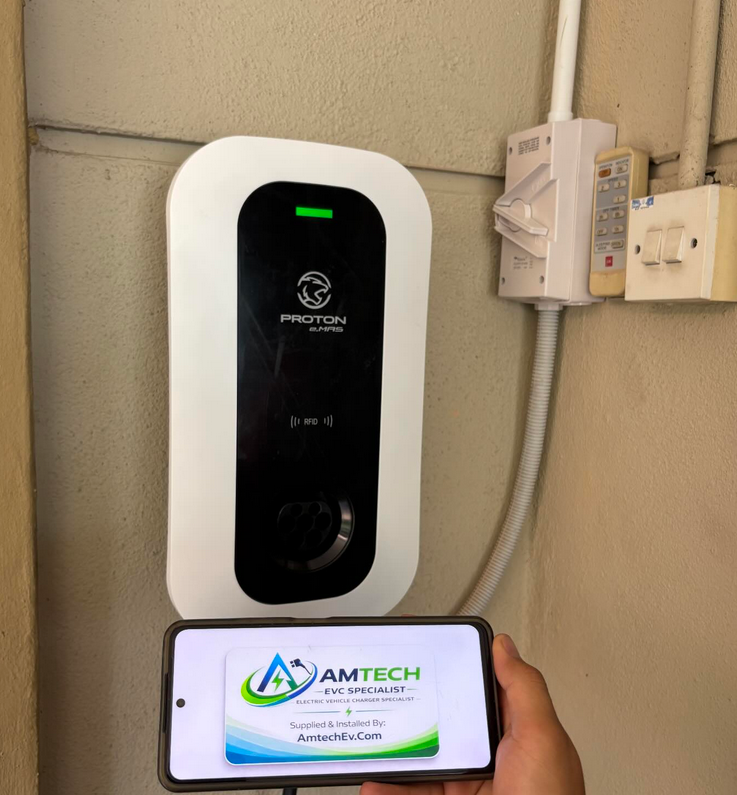
| Smart EV Wallbox (7.4kW – 22kW) | Type 2 socket/tethered, RFID/App control, OCPP 1.6J, built-in 6mA DC RDC-DD | RM 2,800 – RM 5,500 |
| Armored Cabling (XLPE/SWA/PVC) | Fire-retardant steel wire armored cable (6mm² to 16mm²), per meter rate (RM 35 – RM 65/m). Average 30m–60m run. | RM 1,200 – RM 3,600 |
| Protection & Enclosure Panel | Weatherproof IP66 sub-DB, Type B RCCB / Type A+DC, MCB, Type 2 Surge Protection Device (SPD) | RM 650 – RM 1,200 |
| Smart MID Energy Meter | Class 1 digital multi-function energy sub-meter for JMB billing verification | RM 350 – RM 750 |
| Professional Engineering & Labor | Containment (GI trunking/conduit), cabling work, core drilling, earth rod installation, Testing & Commissioning | RM 1,500 – RM 2,800 |
| Fire Safety & Safety Accessories | Emergency Stop isolator switch, 9kg ABC dry chemical fire extinguisher, warning signage | RM 300 – RM 600 |
| JMB Deposit & Admin Fee (Refundable) | Security deposit required by management prior to work commencement | RM 500 – RM 2,000 |
| Total Estimated Investment | Turnkey compliant installation in a Malaysian Strata Property | RM 7,300 – RM 16,450 |
Tax Relief to Offset Your Costs
Under the Malaysian Government’s green mobility incentives, individual taxpayers can claim up to RM2,500 in personal income tax relief for the purchase, installation, rental, or subscription of EV charging equipment. This relief has been extended until the year of assessment 2027. Ensure that your installer issues an itemized official tax invoice to claim this deduction.
Frequently Asked Questions (FAQ)
Can the JMB legally reject my EV charger installation request?
Yes. Under the Strata Management Act 2013, the JMB/MC has the statutory duty to manage common property. If an installation compromises electrical safety, lacks capacity, or fails to meet Bomba guidelines, they are legally empowered to reject it. However, they cannot unreasonably withhold consent if you present a fully compliant, professionally engineered proposal that absorbs all costs and liabilities.
Can I just charge my EV using a standard 3-pin 13A wall socket in the car park?
No. Standard 13A domestic sockets (BS 1363) are not designed for continuous continuous high-amperage draw over 8–12 hours. Doing so presents a severe fire hazard due to resistive thermal heating. Furthermore, tapping into common property sockets without authorization constitutes utility theft under Malaysian law.
What is the difference between single-phase and three-phase charging in a condo?
Single-phase charging operates at 230V up to 32A, delivering a maximum rate of 7.4 kW (adding roughly 35–45 km of range per hour). Three-phase charging operates at 400V, delivering 11 kW to 22 kW (adding 70–120 km of range per hour). Most condominiums have limited electrical capacity, making 7.4kW single-phase or 11kW three-phase the most practical configurations permitted by building managers.
Who handles the maintenance and ongoing inspection of the charger?
The individual owner retains full legal ownership and maintenance responsibility. You are required to maintain an active warranty and ensure periodic inspections by an ST-certified wireman. If the resident moves out, they must either transfer the asset to the new buyer or pay to decommission the circuit and restore the common property to its original condition.