As electric vehicle (EV) adoption accelerates across Kuala Lumpur, Selangor, Penang, and Johor, strata residents face a unique hurdle: overnight home charging within high-rise condominiums and serviced apartments. Unlike landed homeowners who can simply install a 7.4kW or 11kW wallbox onto an existing distribution board (DB), condominium owners navigate shared electrical infrastructure, Joint Management Body (JMB) or Management Corporation (MC) by-laws, and stringent electrical safety frameworks established by Suruhanjaya Tenaga (Energy Commission) and Jabatan Bomba dan Penyelamat Malaysia (JBPM).
At Amtech EV, we engineer turnkey strata EV charging solutions. This comprehensive guide outlines the technical pathways, approval protocols under the Strata Management Act 2013 (Act 757), safety specifications, and transparent cost calculations to bring dedicated EV charging to your designated parking bay.
1. Legal & Regulatory Framework: Strata Management Act 2013 (Act 757)
In high-rise developments, individual parking bays are either accessory parcels attached to a strata title or designated common property licensed to an owner. Running a dedicated electrical sub-circuit across common property—such as electrical risers, driveways, and carpark ceilings—requires formal written consent from the JMB or MC under Act 757.
Key Legal Consideration: Under the Third Schedule of the Strata Management (Maintenance and Management) Regulations 2015, a proprietor shall not alter common property or introduce external fixtures without prior written approval from the Management Corporation. The installation must not cause overloading of shared infrastructure or invalidate the building's fire insurance policies.
2. Electrical Architecture Options for Strata Properties
Engineering an EV charging circuit in a multi-storey car park depends heavily on whether the parking bay is near the main switchboard (MSB), the sub-distribution boards, or the resident's designated TNB meter panel.
Option A: Direct Point-to-Point from Owner's TNB Meter (Meter Compartment)
This is the most popular, equitable, and transparent solution for individual residents in buildings where the residential TNB meter room is situated reasonably close to the car park levels.
- Billing Mechanism: Power consumption is billed directly to the owner's domestic Tenaga Nasional Berhad (TNB) account under Tariff A (Domestic).
- Power Capacity: Typically single-phase (up to 32A / 7.4kW) or three-phase (16A / 11kW or 32A / 22kW), matching the unit's utility incoming supply.
- Infrastructure: A dedicated circuit breaker is added adjacent to the owner's TNB meter, routing through an armored cable along common cable containment racks down to the car park bay.
Option B: Tapping Common Property Sub-DB with an MID-Certified Sub-Meter
If the resident's unit meter is located dozens of floors away in a high-rise tower, routing a cable directly from the unit's meter room down to Basement 3 may be financially prohibitive. In this scenario, tapping into the carpark's common property Sub-Distribution Board (Sub-DB) is feasible, subject to available spare transformer capacity.
- Billing Mechanism: A dedicated Class 1, MID-approved digital energy sub-meter is installed. The resident pays the MC monthly based on actual kilowatt-hour (kWh) readings, usually at TNB's commercial Tariff B rate or a calculated blended rate.
- Load Management: Often paired with Dynamic Load Balancing (DLB) controllers to prevent tripping the building's common services.
Option C: Shared Commercial CPO / Community Wallbox Model
For buildings with severe electrical riser constraints, the JMB/MC may engage an EV Charging Point Operator (CPO) or install smart wallboxes powered by Open Charge Point Protocol (OCPP 1.6J/2.0.1) on shared visitor parking bays. Residents pay via mobile apps (e.g., JomCharge, ChargEV, or Gentari-integrated networks), eliminating individual cable runs.
3. Malaysian Engineering & Fire Safety Standards
EV charging circuits draw continuous heavy current for 4 to 8 hours. Amtech EV adheres strictly to national and international engineering standards to eliminate fire hazards, electric shock risks, and electrical nuisance tripping.
Suruhanjaya Tenaga (ST) Compliance
- MS IEC 61851-1: Electric vehicle conductive charging system — General requirements.
- MS IEC 62196-2: Dimensional interchangeability for Type 2 AC vehicle connectors.
- Protection Devices: Installation of a dedicated Type B Residual Current Circuit Breaker (RCCB), or a Type A RCCB paired with a certified 6mA Residual Direct Current Detecting Device (RDC-DD compliant with IEC 62955). This protects the building from smooth DC fault currents blinding standard AC breakers.
- Dedicated Earthing & Loop Impedance: Earth loop impedance must be tested. Where a TT grounding system is utilized, an auxiliary copper earth electrode must achieve a resistance reading below 10 Ohms.
JBPM (Bomba) EV Guidelines
The Fire and Rescue Department of Malaysia (JBPM) enforces specific spatial guidelines for EV chargers installed within enclosed or basement car parks:
- Installation of an external, weather-rated Emergency Stop Button (Mushroom-head disconnect) within 1.2m to 1.5m height for rapid isolation by firefighters.
- Adequate physical clearance from primary fire sprinkler valves, hose reels, and emergency egress routes.
- Clear bay demarcation and mandatory safety signage detailing fire emergency contact numbers.
4. Step-by-Step Approval Protocol: Navigating the JMB/MC
- Preliminary Site Survey: An Amtech EV certified wireman (minimum PW4 / Competent Person) inspects the car park layout, meter room location, available DB capacity, and cable containment pathways.
- Engineering Dossier Preparation: A technical submission packet is prepared for the Building Management Office. This includes:
- Single-Line Diagram (SLD) signed by a registered electrical engineer.
- Product specification sheets with SIRIM/CE and MS IEC certifications.
- Cable routing map outlining use of existing riser shafts and perforated galvanized cable trays.
- Contractor Public Liability Insurance (minimum RM1,000,000 indemnity coverage).
- JMB/MC Committee Review: The proposal is tabled at the monthly management committee meeting. An indemnity agreement is executed between the owner and the MC covering power usage and damage liabilities.
- Installation & Testing: Installation utilizing Steel Wire Armoured (SWA) or fire-retardant XLPE cables, properly bonded and grounded.
- Testing & Commissioning (T&C): Completion of Form G (Suruhanjaya Tenaga Installation & Supervision Certificate) and Form H (Test Certificate) provided to the MC for archive.
5. Detailed Cost Breakdown (Private Condo Installation)
The cost of installing an EV charger in a Malaysian condominium is primarily governed by cable length and the structural complexity of running cables through fire-sealed concrete slabs.
| Item Description | Technical Specification | Typical Cost (RM) |
|---|---|---|
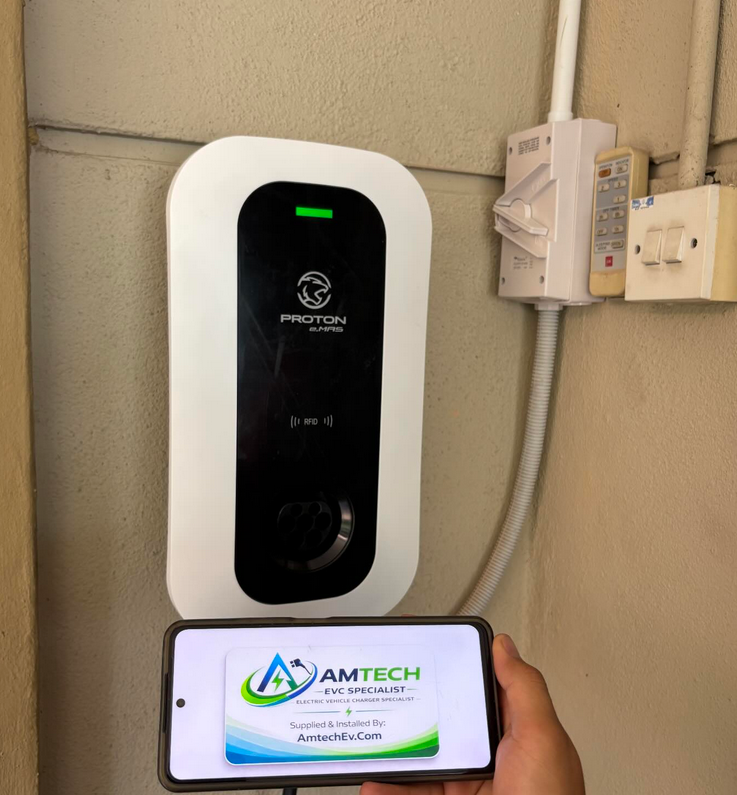
| AC Smart Wallbox (7.4kW - 22kW) | Type 2 tethered/untethered, OCPP 1.6J, RFID, IP54/IK10, Built-in 6mA DC protection | RM 2,800 - RM 4,500 |
| Armoured Cabling & Containment | 4-core or 3-core SWA/XLPE armored cable (6mm² - 10mm²), heavy-duty cable tray & core drilling (per 10 meters) | RM 400 - RM 700 / 10m |
| Electrical Protection Panel | Weatherproof IP66 sub-DB, Type B RCCB / Type A + RDC-DD, 32A/40A MCB, Class II Surge Protective Device (SPD) | RM 650 - RM 1,200 |
| MID Sub-Meter & Emergency Stop | Class 1 digital bi-directional submeter + JBPM-compliant emergency stop button with break-glass/twist reset | RM 350 - RM 600 |
| Professional Services & T&C | Site assessment, Single-Line Diagram (SLD) endorsement, ST Form G/H commissioning, safety testing | RM 500 - RM 1,200 |
| Total Estimated Turnkey Cost | Standard 30m - 50m cable run from meter room to designated bay | RM 4,700 - RM 8,200 |
6. Financial ROI & Tax Incentives
While the upfront investment in a condominium EV setup is higher than a landed home due to containment and cabling distances, the operational savings are significant:
- LHDN Income Tax Relief: Malaysian taxpayers can claim an individual income tax relief of up to RM2,500 for EV charging equipment purchase and installation costs, valid through year of assessment 2027.
- Charging Cost Differential: Charging at home via TNB Domestic Tariff A costs approximately RM0.218 to RM0.57 per kWh. Compared to commercial public DC fast charging networks (which range from RM1.20 to RM1.60 per kWh on ChargEV, Gentari, or JomCharge), home charging saves an average commuter RM250 to RM400 monthly in running costs.
Frequently Asked Questions (FAQ)
1. What happens if my JMB/MC rejects my EV charger application?
Rejections typically stem from safety concerns, lack of spare transformer load, or fears regarding common electrical consumption. Engaging an engineering firm like Amtech EV to provide an endorsed Single-Line Diagram (SLD) along with an electrical load audit demonstrates that your installation will not compromise building integrity. If necessary, a motion can be proposed at the condominium's Annual General Meeting (AGM) to adopt a formal strata EV charging policy under Section 42 of Act 757.
2. Can I share one EV wallbox with my neighbor who parks next to me?
Yes. By utilizing dual-socket smart EV chargers or wallboxes equipped with RFID access control and MID-certified sub-metering, two adjacent car park owners can share the hardware. The internal software tracks consumption per user RFID card, allowing precise split-billing.
3. Do I need approval from Tenaga Nasional Berhad (TNB)?
If you are drawing power from your own existing domestic TNB meter and the total current draw does not exceed your meter's main fuse capacity (e.g., 63A single-phase or 63A three-phase), separate TNB approval is not required. However, if your apartment's total load exceeds the incoming supply requiring a supply upgrade, a formal submission via an Electrical Competent Engineer to TNB is mandatory.